Coach Spotlight: Why Accuracy Alone Won't Fix Your Chess
Published on:
Chess players are surrounded by accuracy scores. Every game gets reduced to a number, and that number quickly becomes the headline. But improvement rarely works that way. Two players can both score 68% accuracy and need completely different advice. One may be throwing away advantages. Another may be surviving bad positions but missing tactical chances. A third may be solid for 30 moves and then collapse when the game gets sharp.
That is the gap Sensei Coach Spotlight is built to close. Instead of telling you only whether a game was good or bad, Spotlight identifies the specific performance patterns that matter most for your next stretch of games, then turns them into a coaching cycle you can actually work on.
Accuracy Is Useful, But It Is Not a Training Plan
Accuracy is a useful summary statistic. It tells you something about move quality across a whole game. The problem is that it usually arrives after the fact and says too little about how to train next. If your score is low, should you study openings? Tactics? Conversion? Endgames? Positional patience? Practical decision-making under pressure?
Strong coaching needs more texture than one number. It needs metrics that separate what type of mistakes you make, when you make them, and which habits are holding you back. That is where Spotlight changes the conversation from “How accurate was I?” to “What should I focus on over my next 10 games?”
What Coach Spotlight Actually Does
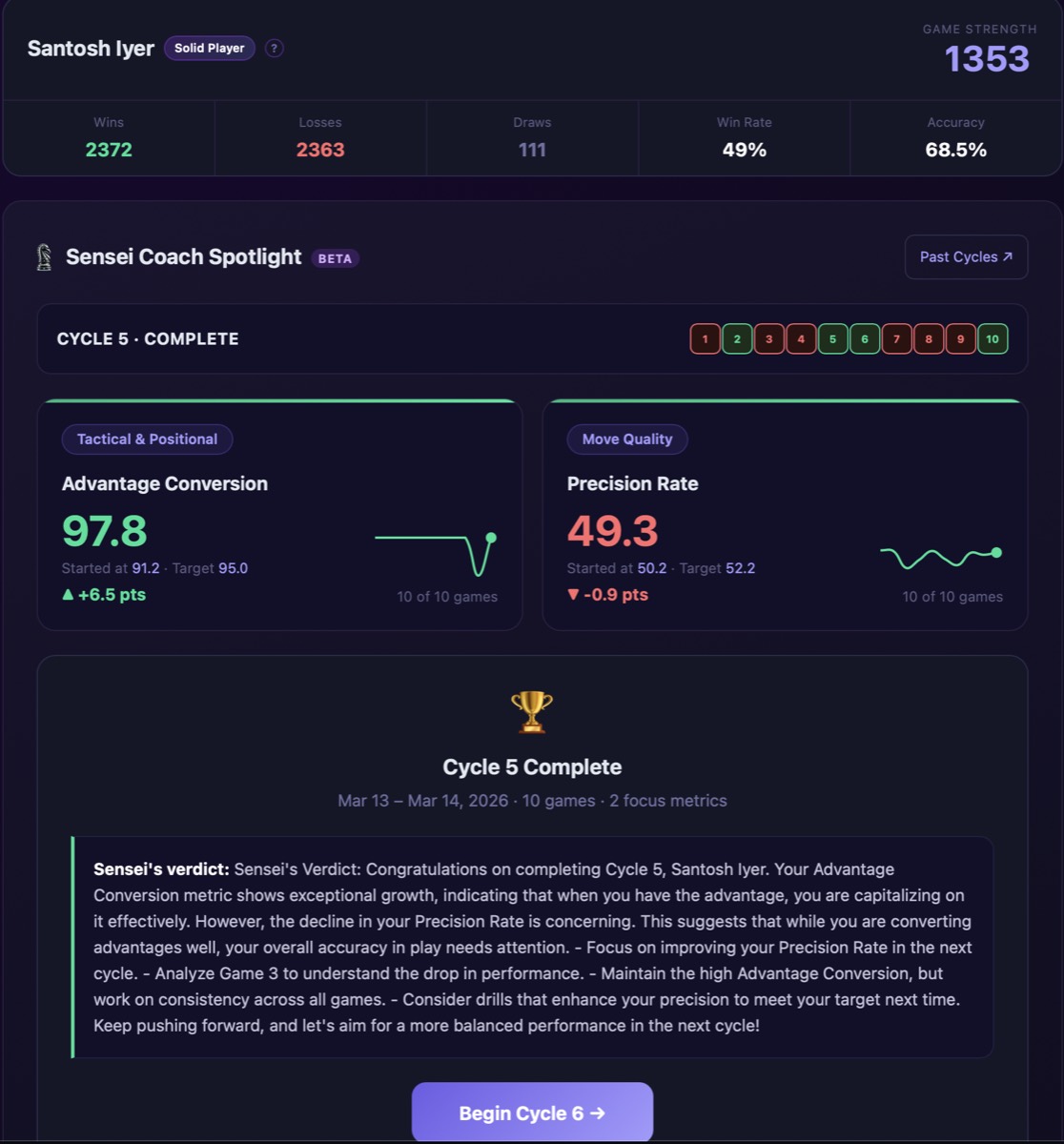
Coach Spotlight locks in two focus metrics for a 10-game cycle. Those metrics are selected from your actual performance patterns, your goals, and your relative strengths and weaknesses. Then Sensei tracks them game by game, shows where you started, where your target sits, and how your trend is moving during the cycle.
In other words, Spotlight takes a pile of analytics and turns it into something much more practical: a short-term improvement mission. The metrics stop rotating every game, which means you have enough stability to work on something intentionally instead of chasing a new dashboard every time you play.
A Better Way to Look at Progress
The chess world often defaults to broad labels like accuracy, blunder count, or rating change. Those all matter, but they can hide the shape of your game. Spotlight looks at a richer set of signals, including things like advantage conversion, precision rate, tactical accuracy, resilience, endgame conversion, and positional stability.
That gives you a much better answer to a simple question: where should my effort go next? If your advantage conversion is excellent but your precision rate is slipping, the takeaway is not “play more games and hope.” The takeaway is that you may already capitalize well when the position is favorable, but still lose value through inconsistent move quality. That leads to a different study strategy than someone whose issue is tactical blindness or opening chaos.
From Metrics to Strategy
The point of Spotlight is not to drown players in numbers. The point is to convert those numbers into coaching decisions. A metric matters because it suggests a training response:
- If your precision rate is weak, you may need slower candidate-move discipline and more blunder-check habits.
- If your advantage conversion is lagging, you may need more work on simplifying, technique, and choosing lower-risk continuations.
- If your tactical accuracy is unstable, you may need pattern-heavy repetition and more forcing-line calculation.
- If your resilience is weak, you may need to improve the quality of your defense after mistakes rather than only your play from equal positions.
That is the real promise here: not generic advice, but a system that helps players build the right study strategy for the version of chess they are actually playing.
A Coaching Cycle, Not a Random Dashboard
One reason improvement stalls is that players rarely stay focused on one area long enough to see whether the work is paying off. Spotlight solves that with cycles. You get a fixed window. You get a baseline. You get a target. You get a running view of how those two metrics are changing across ten games. At the end, Sensei gives you a verdict and pushes you into the next cycle with more context than you had before.
That makes the feedback loop much tighter. You are not just being evaluated. You are being guided. And because the metrics are chosen from your own performance profile, the cycle feels personal instead of generic.
Watch the Onboarding Walkthrough
Why This Matters for Serious Improvement
Most players do not need more analysis in the abstract. They need better prioritization. They need to know what deserves attention now, what can wait, and how to tell whether the work is helping. Spotlight makes that visible. It narrows the field, creates accountability, and gives each cycle a purpose.
If you already like the broader coaching direction behind Sensei, this feature fits naturally with posts like From Analysis to Coaching, Train with Purpose, and The Sensei Philosophy. Spotlight is where those ideas become operational.
Related Reading
- From Analysis to Coaching for the broader case that improvement needs more than engine review.
- Train with Purpose for how goal-based coaching shapes the feedback you receive.
- The Future of Chess Coaching Is Here for the bigger product vision behind Sensei’s coaching stack.
If you are tired of treating every game as just another accuracy score, Coach Spotlight gives you a better frame: identify the metric, build the plan, run the cycle, and learn from the result.